
Grading and Assessment Practice
Definitions
Assessment, grading and reporting are elements of a feedback cycle that supports learning. ASSESSMENT is the ongoing process of gathering a variety of evidence of student learning, and is embedded within the cycles of teaching and learning. Evidence may be collected through a range of developmentally appropriate methods, for example observation, conversation with students, and reviews of student work and performances. GRADING is the process of evaluating student evidence against a set of standards/criteria in order to provide feedback to students about their progress toward the intended learning. REPORTING is the communication of learning progress, growth, and achievement to students, parents and the wider community.
Evidence of Learning
All learning assessments are considered “evidence of learning”. HKIS uses a standards-based approach to teaching and learning. All learning provides a story of a student’s learning journey over time. Whether the learning tasks are small or large in nature, all learning tasks give students the opportunity to show what they know and can do. The learning feedback is always tied to standards and over time students can see how they are performing on certain groups of standards (which we call Measurement Topics) in each class.
Language of Feedback
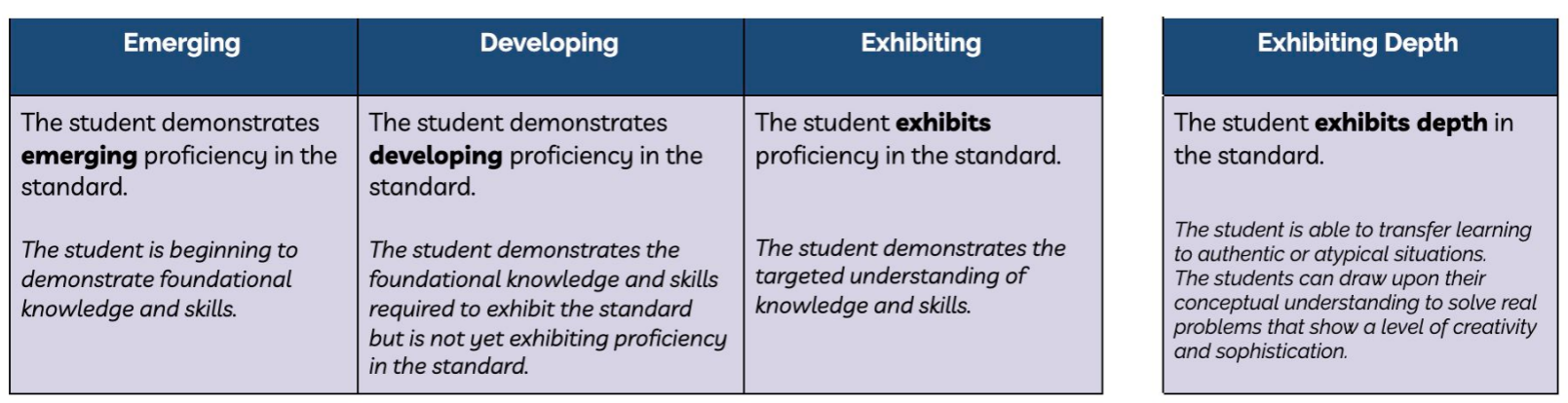
We give feedback on assessments using the General Academic Scale:
Final Grades
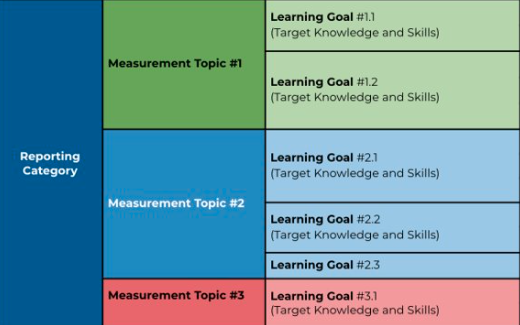
The final grade for the course (at the end of a semester for semester classes, or the end of the year for yearlong classes) will be determined by considering the student’s body of learning evidence over the duration of the course. Students will be given an overall proficiency indicator for each Measurement Topic (a group of standards) and then an overall proficiency for each Reporting Category (a larger bucket of skills and knowledge standards that is communicated on the report card).In Schoology (our learning management system and online grade book), students will see an overall proficiency score for Measurement Topics and Reporting Categories. Learning Goals and Learning Targets are used in class lessons.
All learning evidence is stored in Schoology. Schoology uses ‘averaging’ as a way to determine an overall proficiency indicator. Teachers may dismiss early learning from the average if there is evidence that the student has progressed in knowledge and skills. By dismissing early work the overall proficiency will be based on the most recent and/or most consistent performance and will be an accurate reflection of student learning.A student’s participation, effort, behavior and attendance will not inform the achievement grade.
Approaches to Learning (ATLs)
Learning at HKIS is communicated with proficiency indicators and letter grades but also in our Approaches to Learning. The Approaches to Learning descriptors highlight a student’s ability within the class to actively engage in the learning experience and fulfill their potential as self-motivated, lifelong learners. They are behaviours that facilitate, broaden, or extend learning. “These may be things that enable learning, such as performance on formative assessments, homework, and class participation. They also may reflect extended learning goals related to noncognitive social-emotional learning skills such as collaboration, goal setting, perseverance, habits of mind, or citizenship” (Guskey, 2020). At HKIS, our Approaches to Learning measure a student’s ability to demonstrate Self Motivation, Collaboration, and Respect and Responsibility.
Assessment, Grading, & Reporting Agreements
SECTION A: Assessment, Grading, & Reporting Vocabulary
General Academic Scale: This is the scale that we use to communicate a student’s proficiency level toward the measurement topics.
Approaches to Learning
| Behaviors | Seldom | Inconsistent | Consistent | |
|---|---|---|---|---|
| Self-Motivated Learning | Willingly apply a variety of learning and motivation strategies throughout their learning process. | |||
| Collaboration | Uses a variety of methods within diverse environments to communicate and respectfully work together to support individual learning to contribute to the learning of others. | |||
| Respect & Responsibility | Organized and prepared to learn. Respects others and the learning environment. |
Proficiency Level: This is the overall proficiency (emerging, developing, exhibiting, exhibiting depth) attributed to the Measurement Topic being assessed.
Evidence of Learning: Any task that demonstrates a student’s understanding of a learning goal and/or corresponding measurement topic.
Formative: Formative feedback is designed to give students feedback over time that will enable them to set goals and move forward with their learning as opposed to making a final judgment about a student’s ability. In Schoology, formative tasks are not included in the body of evidence used to make a determination about a student’s proficiency level but may be used as a reference if the summative data is not clear and it supports a higher grade for the student.
Summative: Summative feedback is designed to capture a student’s performance at one point in time after instruction and to make a judgment about the student’s ability according to a grade-level benchmark. Summative assessments evaluate student learning on the full General Academic Scale (in other words, all summative assessments must use all descriptors on the General Academic Scale). These assessments are used to inform report card grades.
Approaches to Learning: At HKIS we separate behaviours from academic achievement. Approaches to learning behaviors are assessed as seldom, inconsistent, or consistent. The ATLs are Self-motivated learning, Collaboration, and Respect and Responsibility.
SECTION B: Common Course Guidelines
Common Assessment Expectations: We believe that students should have a shared learning experience within the same course. This means that summatives and key formatives are common. Courses that are shared among teachers must use the same rubric for summative assessments. Teachers should also calibrate key formatives and summative assessments during the year to ensure consistency of expectations.
Home Learning: Home learning is just one component of the learning process; it should not dominate a student’s time outside of the classroom. While teachers recognise the importance of this balance, it is also important that students recognise the need for this balance when selecting courses. We believe that home learning should:
- contain relevant and meaningful tasks that give students a clear sense of progress.
- be differentiated when appropriate, with some choice about tasks based on a student’s individual needs.
- be developmentally appropriate.
- align with the “Dragon Ratings” published in the High School Academic Handbook and time guidelines in the Middle School Student Handbook.
- not be assigned over extended holidays (one week and longer) or during Interim/PEAK. The only exception when it is permissible to give work over an extended holiday would be if a student needs to make up missed work. In addition, no long-term assignments can be due, nor summative assessments are given, the first class meeting after an extended break.
SECTION C: Feedback and Reporting Student Learning
HKIS provides students and families with feedback on student learning throughout the year including during classroom instruction, via the Schoology Gradebook, and during Student-Involved Conferences in the fall and spring semesters.
Required Evidence of Learning:
- Reporting Category: Teachers must have a minimum of three (3) pieces of evidence of learning per reporting category per semester in the Schoology gradebook.
- Approaches to Learning: Teachers must have two to four (2-4) pieces of evidence per semester.
- Cooperative Learning: HKIS does not give group proficiency levels of grades. Any group activities must have an opportunity for students to individually show evidence of their learning.
Returning Assignments: Teachers will provide written feedback and establish proficiency levels for summative assessments within one eight-day cycle following submission. In special circumstances of a longer assessment or need for conferencing, before a final proficiency level is established, two eight-day cycles is permitted.
Determining Proficiency Levels for Each Reporting Category: Schoology calculates a proficiency level for each measurement topic and reporting category. Teachers ensure the proficiency levels at the measurement topic and reporting category level accurately reflect a student’s current level of proficiency at the quarter and at the semester. Overall proficiency levels should be determined by one of the following methods:
- Most Consistent: for discrete Measurement Topics
- Most Recent and Consistent: for spiraling Measurement Topics
Report Cards: Report cards are issued at the end of each semester. For full-year courses, the semester 1 report card is a progress update based on student work up to that point. For each course, report cards include a course overview, the student’s attendance for the semester, the overall proficiency level for each reporting category, and Approaches to Learning.
SECTION D: Scheduling of Summative Assessments
Calendaring of Summative Assessments: Students will be informed of the expected learning goals, success criteria, and methods of assessment at the beginning of a unit of study. Teachers will communicate and publish to Schoology a date for summative assessments at least three class periods in advance.
Maximum Number of Summatives in a Day: Students are expected to complete no more than two summative “in class” assessments, in two different courses, in a day. A summative is defined as an assessment that occurs in class and takes more than ½ the class to complete. Projects that are completed over a series of lessons are not included in this agreement. A student may inform a teacher of the last published summative assessment to request that the third or fourth assessment they are expected to complete on a given day be rescheduled. Any student request must be made at least 1 class in advance.
Assessments after an Extended Holiday: Home learning will not be assigned over extended holidays (one week and longer) or during Interim/PEAK. The only exception when it is permissible to give work over an extended holiday would be if a student needs to make up missed work. In addition, no long-term assignments can be due, nor summative assessments are given, the first class meeting after an extended break (the first two days of school).
Absences: Students who have an unexcused absence for a class where there was a planned summative will not have the opportunity to make up that summative. An IE will be recorded in the gradebook for that summative.
SECTION E: Late and Incomplete Assignments
Students are expected to show responsibility for their learning and submit all assignments on time. Missing assignments will be reflected in the gradebook as an IE (insufficient evidence) until complete. Consistently submitting learning past the due dates will be reflected in the student’s Approaches to Learning grade.It is our expectation that students submit learning on time. Teachers will not accept assignments that are submitted more than one eight-day cycle after the due date excluding extenuating circumstances that must be discussed with the teacher in advance. This agreement does not give students permission to submit learning after the deadline but should only be used if there are circumstances that the student has discussed with the teacher in advance. If a student does not submit the assignment within an eight-day cycle, the teacher will involve the student's counselor and the Assistant Principal for Academics for follow-up.
SECTION F: Reassessment
We believe that students learn at different rates and, therefore, reassessment opportunities will be provided to students to support their learning. Teachers will use formative assessments, summative assessments, and reassessments to provide students with opportunities to meet the standards. Intervention and reassessment will occur when the teacher determines that students are not exhibiting the learning goals.In Middle School, students who are yet to Exhibit proficiency in a Measurement Topic have an opportunity to reassess summative assessments.
Discrete Learning Goals: Discrete learning goals require a discrete reassessment opportunity.
Spiraling Learning Goals: When content and/or skills will be assessed in a later unit of study, reassessment may occur on a later assessment. Teachers may decide to give a reassessment at any time, even if the learning goal spirals, if they deem it necessary for student learning. Reassessments may range from an individual student to the entire class. Only one formal reassessment opportunity will be allowed per summative. However, exceptions may be made within the teaching team. When reassessment is possible, students must meet the following requirements:
- All agreed-upon formative learning has been completed prior to the summative assessment.
- Complete the original task or assessment on the date it was scheduled (unless there is an extenuating circumstance).
- Complete relearning activities as determined by the teacher and show evidence of improved performance. The reassessment proficiency will be documented. In cases where a student’s proficiency is lower after reassessment the original proficiency stands and a comment is made with the reassessment grade.
When tasks/assignments are reassessed, they may be reassessed partially, entirely, or in a different format, as determined by the teacher. Teachers should notify parents/guardians if a teacher is requiring a student to reassess. Reassessment should typically occur within one eight-day cycle of the return of the assessment. Teaching teams may use discretion to determine, if, in extenuating circumstances, a second eight-day cycle is required.
Following reassessment, students’ performance replaces the original grade in Schoology. The original grade should be documented in Schoology comments. If the reassessment grade is lower than the initial grade, the original grade will stand, and the reassessment score will be reported in the comments.Long-term projects where feedback has been given over the course of the project and final measures of learning such as end-of-course/semester exams and culminating projects/performances may not be reassessed. Last Reviewed 4 June 2024